Maintaining Saab Turbo Engines: Shop Insights
Saab turbocharged engines are legendary for their balance of performance, efficiency, and longevity—when properly maintained. If you own or service a Saab 900, 9000, 9-3, 9-5, or any other turbocharged Saab model, understanding and anticipating the unique needs of these engines is crucial for reliability and driving enjoyment. This comprehensive guide distills field-tested shop practices and technical advice to help you maximize the lifespan and performance of your Saab’s turbo engine, avoid common failure points, and source the right parts. For a deeper dive into Saab part fitment, sourcing, and heritage, see our Saab OEM & Genuine Auto Parts: Technical Fitment, Heritage & Sourcing | AutoPartEx category page.
Immediate Answers: The Essentials of Saab Turbo Engine Longevity
What keeps a Saab turbo engine alive and healthy? The key pillars are consistent oil changes with the correct specification, vigilant cooling system maintenance, attention to turbocharger health, and using only high-quality, correctly fitted OEM or genuine parts. Neglect in any of these areas can trigger cascading failures that are time-consuming and costly to repair.
Quick Checklist for Saab Turbo Engine Health:
- Use only manufacturer-specified full synthetic oil and change it at or before recommended intervals.
- Replace oil and air filters with genuine or premium aftermarket units.
- Inspect and service the PCV (positive crankcase ventilation) system regularly.
- Monitor coolant levels and replace coolant as specified.
- Address any check engine lights or fault codes immediately.
- Allow engine to warm up before hard driving and cool down after spirited runs.
- Use fuel and ignition system parts that meet or exceed OEM specifications.
- Source turbocharger rebuilds or replacements from verified Saab specialists.
Hidden Problem: Why Saab Turbo Engines Fail Prematurely
Despite their robust engineering, many Saab turbo engines face preventable failures—often due to overlooked maintenance, improper parts, or misunderstanding of the turbo’s unique demands. Typical trouble spots include oil sludge, turbocharger bearing wear, cracked exhaust manifolds, and failed PCV systems. These issues rarely occur in isolation; one neglected system often stresses others, accelerating wear.
A common scenario: A Saab owner, lured by bargain oil or generic filters, skips a few oil changes. Over time, oil breakdown and contamination clog oil passages, starving the turbo of lubrication. The result? Turbo bearing failure, oil leaks, and, potentially, catastrophic engine damage. Understanding these interconnections is vital for anyone committed to Saab turbo engine longevity.
Understanding the Saab Turbo: Engineering and Unique Maintenance Needs
Saab’s turbocharged engines are not just “regular” engines with a turbo bolted on. Decades of innovation—from the original 99 Turbo through the 9-5 Aero—mean each system is engineered to withstand higher pressures, temperatures, and lubrication demands. Key differentiators include:
- High-Temperature Tolerance: Turbochargers dramatically increase exhaust and oil temperatures. Saab engines use oil coolers, sodium-filled valves, and reinforced pistons to handle the heat.
- Pressurized Lubrication: Turbo bearings rely on a constant, clean oil supply. Even brief oil starvation can cause irreparable damage.
- PCV System Complexity: To avoid crankcase pressure buildup (which can push oil past seals), Saab employs advanced PCV systems that need periodic inspection and updating.
- Boost Control: Saab’s APC (Automatic Performance Control) and later Trionic systems manage boost and ignition to prevent engine knock and maximize efficiency—dependent on healthy sensors and actuators.
Because these systems are intertwined, a failure in one area (such as a blocked PCV valve or faulty boost control solenoid) can quickly cascade into more serious engine or turbo damage.
The Oil System: Lifeblood of Saab Turbos
Oil-related failures account for a majority of premature Saab turbo engine deaths. The turbocharger’s bearings spin at up to 200,000 RPM and are lubricated exclusively by engine oil. Any contamination, breakdown, or low oil pressure directly threatens both the turbo and the engine.
Key Oil System Practices:
- Use the Right Oil: Saab turbo engines require fully synthetic, high-temperature-rated oil (typically 0W-40 or 5W-40 for most models). Conventional oil cannot withstand turbo heat cycles.
- Change Oil Frequently: Exceeding Saab’s recommended intervals (often 5,000–7,500 miles for turbo models) increases the risk of sludge and varnish deposits.
- Replace Oil Filters with OEM or Premium Brands: Cheap filters can collapse or bypass, allowing debris to circulate.
- Inspect for Leaks: Oil leaks from the turbo oil feed or return lines can cause rapid oil loss and catastrophic turbo failure.
Warning Signs:
- Blue smoke from exhaust (oil burning)
- Whining or siren noise from turbo (bearing wear)
- Oil in intercooler or intake piping
Cooling System Vigilance: Preventing Overheating and Turbo Damage
Turbocharged engines generate significantly more heat than their naturally aspirated counterparts. Saab’s cooling systems are robust but require proactive maintenance to prevent hot spots, gasket failures, and turbo overheating.
Cooling System Maintenance Checklist
- Flush coolant every 2–3 years with Saab-approved coolant.
- Inspect radiator and hoses for leaks, swelling, or brittleness.
- Replace thermostat and coolant temperature sensor as preventive maintenance every 5–7 years.
- Check water pump for noise or leaks at each major service.
- Monitor heater core for signs of leakage (wet carpets, fogging windows).
Neglecting the cooling system can lead to:
- Head gasket failure (overheating)
- Warped cylinder heads
- Turbocharger coking (oil carbonization in turbo bearings)
- Cracked exhaust manifolds
Air, Fuel, and Ignition: Keeping the Turbo Happy
The forced induction of a turbocharger amplifies any weaknesses in the air, fuel, or ignition systems. Saab’s Trionic engine management is sophisticated but depends on sensors and actuators functioning within tight tolerances.
Critical Maintenance Points:
- Air Filter: Replace at least annually with a genuine or high-quality filter to prevent MAF sensor contamination.
- Fuel Filter: Replace every 30,000–60,000 miles (check your model’s interval).
- Spark Plugs: Use only NGK or OEM-specified plugs gapped to correct spec; incorrect plugs can cause misfire and detonation.
- Ignition Coils and DI Cassettes: Failure is common at 80,000–120,000 miles. Use OEM replacements—aftermarket units are less reliable.
- Boost Control Solenoid: Replace as preventive maintenance every 60,000–100,000 miles; failure can cause overboost or underboost.
Symptoms of Trouble:
- Hesitation or surging under boost
- Check engine light for misfire or lean/rich codes
- Loss of power or excessive fuel consumption
PCV System: The Silent Saab Turbo Killer
The PCV (Positive Crankcase Ventilation) system on Saab turbos is more complex than on most cars, owing to the need to manage high crankcase pressures under boost. Early 9-3 and 9-5 models, in particular, were prone to oil sludge and engine failure due to inadequate PCV design.
Saab PCV System Service Table:
| Model/Year | Recommended PCV Update/Service |
|---|---|
| 900/9000 (pre-1998) | Inspect hoses, clean oil separator annually |
| 9-3 (1999–2003) | Install PCV Update Kit #6, inspect annually |
| 9-5 (1999–2003) | Install PCV Update Kit #6, inspect annually |
| 9-3/9-5 (2004+) | Inspect hoses, clean/check oil trap annually |
Warning Signs:
- Oil leaks at valve cover or rear main seal
- Excessive oil consumption
- Sludge under oil filler cap
Solution: Always install the latest PCV update kit and inspect hoses for blockages or collapse during every oil change.
Turbocharger Health: Diagnosis and Replacement
The turbo itself is a wear item, especially if starved of oil or exposed to excessive heat. Early detection of turbo issues can save the engine from collateral damage.
Turbo Failure Symptoms
- Whistling, whining, or siren noises on boost
- Blue or gray exhaust smoke, especially after idling
- Oily residue in intercooler piping or intake
- Loss of boost pressure/power
Turbo Inspection Steps
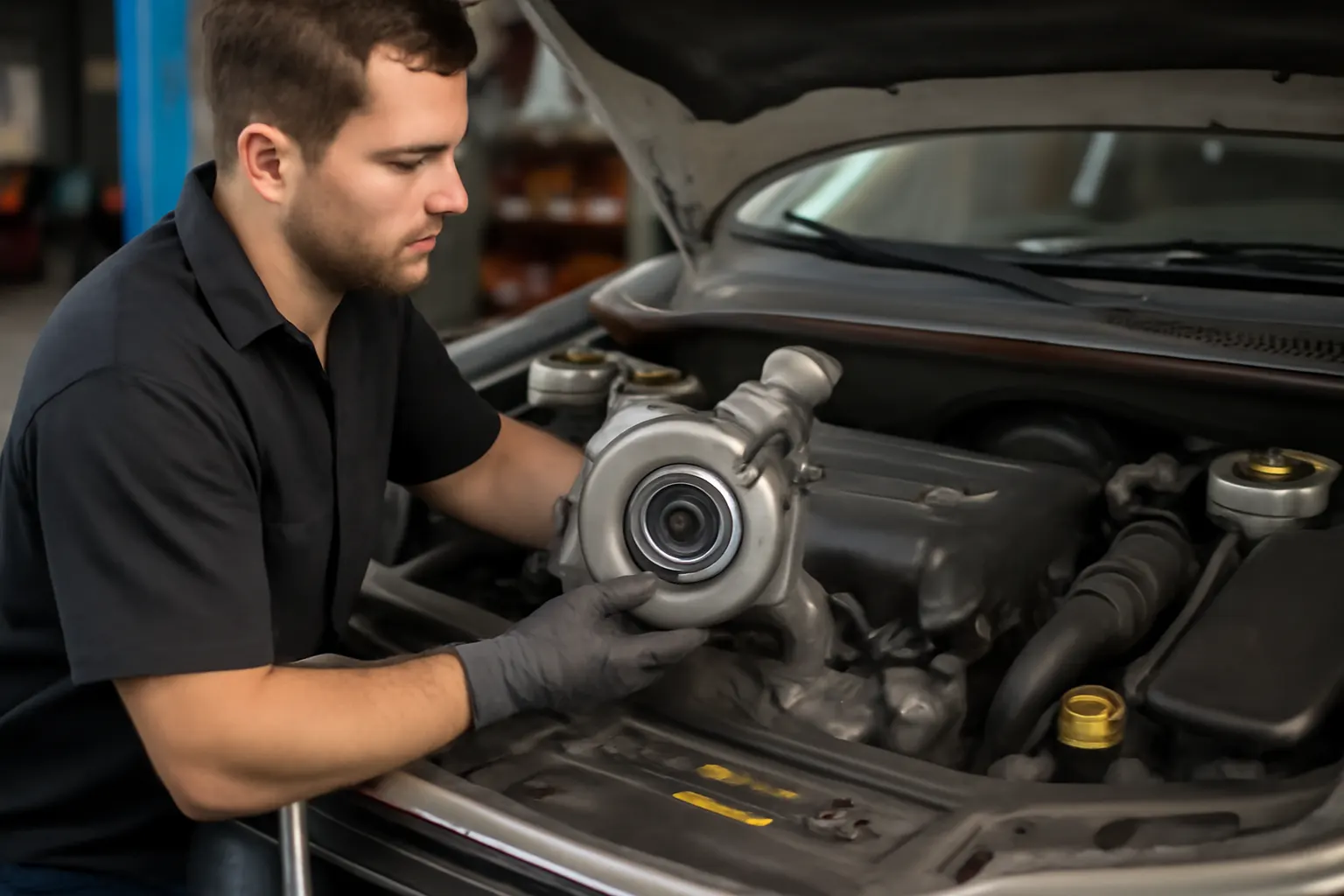
- Check for Shaft Play: Remove intake pipe and feel for radial and axial play. Any significant movement means rebuild/replacement is needed.
- Inspect Oil Feed/Return Lines: Look for leaks or restrictions.
- Assess for Oil Leaks: Check compressor and turbine housings for oil.
- Scan for Overboost/Underboost Codes: Use a diagnostic tool to read DTCs.
Replacement Advice: Use only OEM or reputable remanufactured turbochargers. Cheap aftermarket turbos are notorious for short lifespans and poor fitment. Always replace oil feed and return lines and prime the turbo with oil before first startup.
Exhaust, Intake, and Intercooler: Supporting the Turbo
Saab’s turbocharged engines rely on a free-flowing exhaust and intake system to maximize efficiency and longevity. Cracked exhaust manifolds and clogged intercoolers are common on high-mileage cars.
Maintenance Recommendations:
- Inspect exhaust manifold for cracks or leaks every 60,000 miles.
- Replace exhaust manifold gaskets at signs of leakage.
- Clean intercooler and intake piping every 50,000 miles to remove oil and debris.
- Check all intake and intercooler hoses for splits, swelling, or loose clamps.
Performance Tip: Aftermarket “performance” air filters can allow more dirt into the engine and MAF sensor—stick with OEM or high-quality paper filters for best longevity and sensor life.
Electronics and Sensors: The Trionic System’s Watchdogs
Saab’s Trionic engine management system is highly advanced, using ion-sensing ignition, knock detection, and adaptive boost control. These systems depend on accurate sensor data.
Key Sensors to Monitor:
- Mass Air Flow (MAF) Sensor: Clean or replace if readings are erratic or if check engine light appears.
- Manifold Absolute Pressure (MAP) Sensor: Critical for accurate boost measurement.
- Oxygen Sensors: Replace at recommended intervals for optimal fuel economy and emissions.
- Coolant and Intake Air Temperature Sensors: Faulty readings can cause over-fueling or detonation.
Diagnostic Tip: Use a Saab-compatible scan tool to monitor live data and fault codes. Address sensor issues immediately to prevent engine damage.
Sourcing Genuine Saab Parts: Why Quality Matters
With Saab no longer in production, sourcing high-quality parts is more important than ever. Using genuine or OEM-equivalent parts ensures the correct fit, material quality, and longevity—especially for critical engine and turbo components.
Where to Source
- Saab Specialist Suppliers: Many Saab specialists stock genuine and OEM parts for turbo engines.
- AutoPartEx: Our Saab OEM & Genuine Auto Parts: Technical Fitment, Heritage & Sourcing | AutoPartEx page provides guidance on sourcing verified parts.
- Avoid Generic Aftermarket: Cheap parts may fit, but often lack the durability, material quality, and engineering required for Saab’s turbo systems.
For more on identifying genuine parts, see our guide: How to Spot Genuine Saab Parts.
Fitment and Compatibility: Avoiding Costly Mistakes
Correct part fitment is crucial. Saab turbo engines are sensitive to even minor deviations in turbochargers, sensors, PCV components, and gaskets.
Fitment Checklist:
- Cross-check part numbers using reputable fitment guides.
- Confirm turbocharger model and flange compatibility.
- Use only PCV kits, sensors, and DI cassettes specified for your engine code.
- Replace all gaskets and seals during major service—reusing old gaskets is a false economy.
For a detailed fitment resource, consult our Saab Parts Fitment & Compatibility Guide.
Driving Habits: Protecting Your Turbo Investment
Even with perfect maintenance, how you drive your Saab turbo matters. Turbocharged engines benefit from gentle warm-up and cool-down routines.
Best Practices:
- Warm Up: Drive gently for the first 5–10 minutes to allow oil and coolant to reach operating temperature.
- Cool Down: After hard driving, idle for 1–2 minutes before shutting off to allow the turbo to cool and prevent oil coking.
- Avoid Lugging: Don’t accelerate hard at low RPM; let the turbo build boost smoothly.
- Monitor Gauges: Keep an eye on oil pressure, temperature, and boost gauges for any anomalies.
Advanced Diagnostics: When to Seek Expert Help
Some Saab turbo issues require specialized tools and experience to diagnose and repair. If you encounter persistent check engine lights, unexplained oil consumption, or repeated turbo failures, consult a Saab specialist or a shop with Saab Trionic diagnostic capability.
When to Seek Expert Help:
- Chronic oil leaks or consumption not solved by PCV updates
- Repeated turbocharger failures despite correct oiling and cooling
- Persistent boost control or engine management faults
- Unusual noises or vibrations under boost
Expert shops can perform compression and leakdown testing, smoke testing for intake leaks, and advanced Trionic system diagnostics.
AutoPartEx: Your Partner for Saab Turbo Engine Longevity
At AutoPartEx, we understand the technical heritage and unique maintenance needs of Saab turbocharged engines. Our curated parts catalog, technical fitment guides, and sourcing network are designed to keep your Saab running at its best for years to come. Whether you’re searching for a rare turbo component or need advice on fitment, our resources—including Sourcing Rare Saab Parts: Owner Experiences—offer trusted guidance.
For the complete picture on Saab part compatibility and sourcing, explore our Saab OEM & Genuine Auto Parts: Technical Fitment, Heritage & Sourcing | AutoPartEx category page.