
Advertisement
Selecting the optimal gear ratio for your rear-wheel drive (RWD) vehicle is a pivotal decision that directly influences performance, fuel economy, and towing capability. Whether you're driving a daily commuter, a performance car, or a workhorse truck, the gear ratio in your Rear Axle Assembly (RWD) sets the tone for how your vehicle behaves on the road, at the track, or on the job. This guide unpacks the technical and practical considerations of gear ratio selection, addresses common pitfalls, and delivers actionable expertise for enthusiasts and professionals alike.
Immediate Answer: Why Gear Ratio Matters
In essence, the gear ratio of your RWD vehicle’s rear axle determines how engine power is translated into wheel torque and speed. A numerically higher (shorter) ratio, such as 4.10:1, multiplies torque for better acceleration and towing but increases engine RPM at cruising speeds, impacting fuel economy. Conversely, a numerically lower (taller) ratio like 3.08:1 lowers engine RPM at highway speeds, improving efficiency but reducing off-the-line punch and towing strength.
Key Impacts of Gear Ratio Choice:
- Performance: Shorter ratios deliver faster acceleration.
- Fuel Economy: Taller ratios improve highway efficiency.
- Towing/Hauling: Shorter ratios help move heavy loads more easily.
Understanding these trade-offs is essential for aligning your gear ratio with your driving needs.
The Hidden Problem: One Size Never Fits All
Many drivers and even some technicians make the mistake of assuming the factory gear ratio is always ideal, regardless of modifications or usage changes. However, changes in tire size, engine upgrades, vehicle weight, or intended use (e.g., towing, off-roading, racing) can render the original ratio suboptimal. This can lead to sluggish acceleration, poor towing performance, or disappointing fuel economy.
Common Overlooked Issues:
- Upgrading tire diameter without adjusting the gear ratio can degrade performance and speedometer accuracy.
- Engine modifications may shift the power band, necessitating a new ratio for optimal results.
- Using a gear ratio suited for performance in a vehicle primarily used for highway commuting can result in excessive fuel consumption and noise.
Ignoring these factors often leads to a mismatch between vehicle capability and owner expectations.
Technical Deep Dive: How Gear Ratios Work
What Is a Gear Ratio?
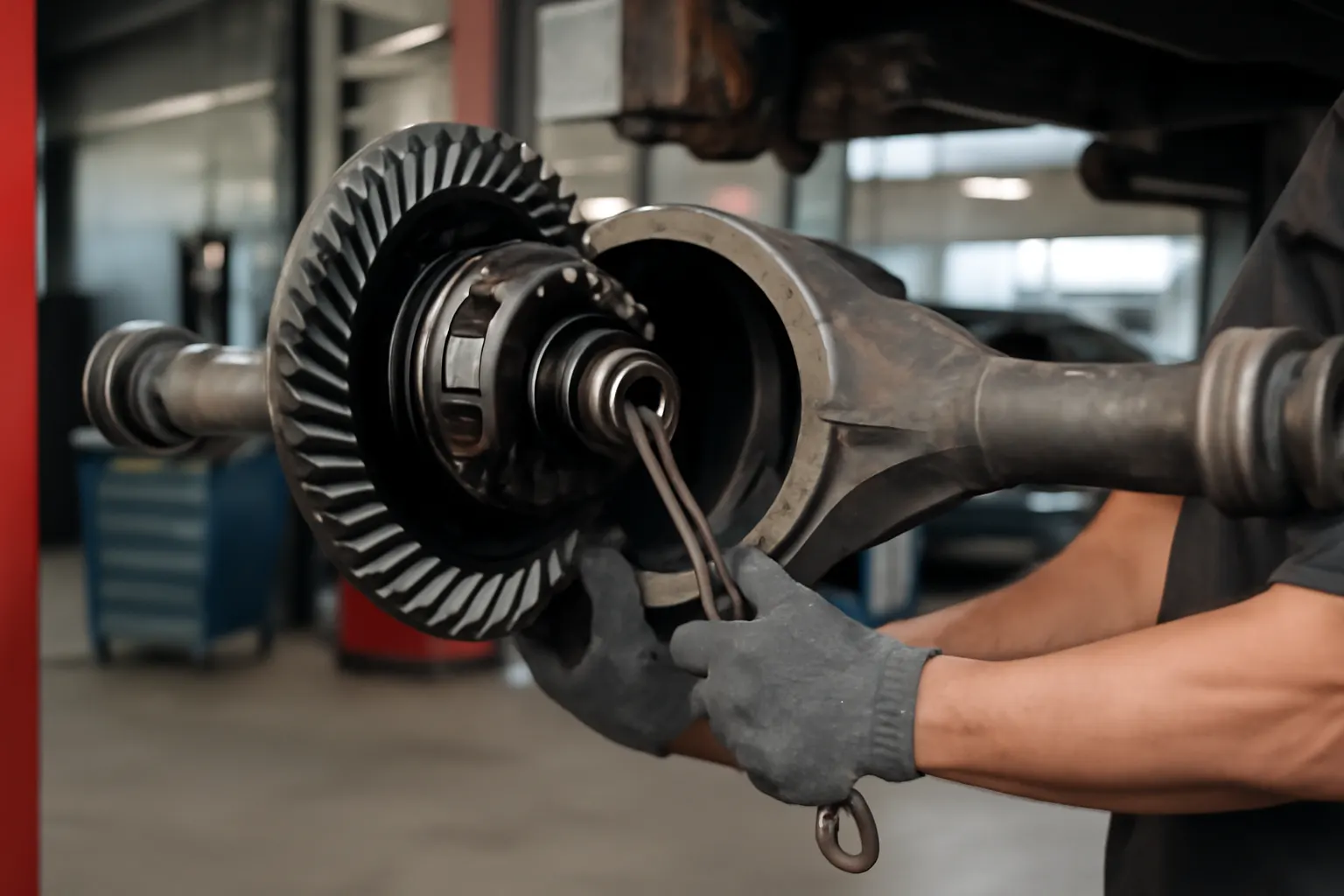
The gear ratio in a rear axle assembly is the relationship between the number of teeth on the ring gear and the pinion gear. For example, a 4.10:1 ratio means the driveshaft (connected to the pinion) must rotate 4.10 times to turn the axle (and thus the wheels) once.
Gear Ratio Formula:
Gear Ratio = (Number of Ring Gear Teeth) ÷ (Number of Pinion Gear Teeth)
Torque Multiplication and Engine RPM
- Higher Ratio (e.g., 4.10:1): Multiplies torque more, increasing acceleration and towing power but also engine RPM at a given speed.
- Lower Ratio (e.g., 3.08:1): Reduces torque multiplication, slowing acceleration but lowering engine RPM for better fuel economy.
Interaction with Transmission and Tire Size
Gear ratio doesn’t work in isolation. It interacts with transmission gearing and tire circumference to determine final drive ratio and vehicle behavior. Larger tires effectively "tall" the overall ratio, requiring compensation with a numerically higher axle ratio to restore performance.
Performance, Efficiency, and Towing: The Balancing Act
Performance-Focused Ratios
Enthusiasts seeking rapid acceleration or track performance gravitate toward higher (numerically) ratios (e.g., 4.10:1, 4.56:1). These ratios deliver stronger launch characteristics and keep the engine in its power band under hard acceleration.
Pros:
- Improved 0–60 mph times
- Stronger throttle response
Cons:
- Higher engine RPM at cruising speeds
- Increased fuel consumption
- More wear on engine and drivetrain components
Advertisement
Fuel Economy-Oriented Ratios
For daily drivers and highway commuters, lower (numerically) ratios (e.g., 3.08:1, 2.73:1) keep engine RPM low at speed, reducing fuel usage and noise.
Pros:
- Better highway fuel efficiency (DOE: Fuel Efficiency)
- Reduced engine wear at cruise
Cons:
- Slower acceleration
- Less effective for towing or hauling
Towing and Heavy-Duty Use
Work trucks and towing vehicles benefit from higher ratios, which provide the torque multiplication necessary to move heavy loads from a stop and maintain control at low speeds.
Key Considerations:
- Manufacturer recommendations for towing ratios
- Trailer weight and gross combined vehicle weight rating (GCVWR)
- Transmission cooling and axle strength
Diagnosing Gear Ratio Mismatch: Symptoms and Checks
A mismatched gear ratio can present as sluggish acceleration, excessive fuel consumption, or improper speedometer readings. Diagnosing such issues requires a systematic approach:
Checklist: Signs of Gear Ratio Problems
- Acceleration Lag: Vehicle feels slow off the line or when loaded.
- High RPM at Highway Speeds: Tachometer reads higher than expected at cruising speeds.
- Speedometer Error: Speedometer reading is inaccurate after tire or gear changes.
- Poor Towing Performance: Difficulty maintaining speed or climbing grades with a trailer.
- Unusual Drivetrain Noise: Whining or howling from the rear axle under load.
If you detect one or more of these symptoms, the rear axle ratio may need reassessment.
Calculating the Right Gear Ratio for Your Application
Step 1: Define Your Priorities
- Performance: Track, autocross, or spirited driving
- Efficiency: Highway commuting, long-distance travel
- Towing/Hauling: Work truck, RV, or boat towing
Step 2: Gather Key Data
- Transmission gear ratios (especially overdrive ratios)
- Tire diameter (actual measured, not just sidewall size)
- Engine power band (RPM range for peak torque and horsepower)
Step 3: Use the Gear Ratio Calculator
A common formula to estimate the ideal gear ratio for your needs:
Ideal Gear Ratio = (Desired RPM × Tire Diameter × Transmission Ratio) ÷ (Vehicle Speed × 336)
- Desired RPM: Target engine speed at cruise (e.g., 2,000–2,400 RPM for fuel economy)
- Tire Diameter: In inches
- Transmission Ratio: Top gear or overdrive ratio
- Vehicle Speed: Typical highway speed in MPH
Step 4: Consult Manufacturer Guidelines
Always cross-reference your calculated ratio with manufacturer recommendations, especially when towing or carrying heavy loads. Check the owner's manual or technical service bulletins for axle ratio options.
Gear Ratio Selection: Practical Examples
Daily Driver Example
A sedan with a 2.73:1 axle ratio and overdrive transmission will cruise at low RPM, maximizing fuel efficiency. If you upsize the tires, consider moving to a slightly higher ratio (e.g., 3.08:1) to maintain acceleration and speedometer accuracy.
Performance Build Example
A muscle car with a naturally aspirated V8 may benefit from a 3.73:1 or 4.10:1 ratio for improved quarter-mile times and aggressive street performance. Be prepared for higher RPM and fuel use at highway speeds.
Towing Example
A full-size pickup towing heavy trailers may require a 4.10:1 or even 4.56:1 ratio, especially with larger tires, to ensure strong launch and climbing power.
Installation and Maintenance Considerations
Professional Installation Is Key
Changing a rear axle gear ratio is a precision job involving pinion depth, backlash, and bearing preload. Incorrect installation can lead to gear noise, premature wear, or catastrophic failure.
Installation Essentials:
- Use new bearings, shims, and seals.
- Set backlash and pinion depth per manufacturer specs.
- Break-in new gears with gentle driving and fluid changes.
Maintenance Tips
- Regularly check for leaks at the rear axle seals and pinion seal.
- Replace differential fluid at recommended intervals, especially after hard use or towing.
- Listen for changes in axle noise—early detection can prevent costly repairs.
For more on axle maintenance, see Rear Axle Seal Replacement: Preventing Leaks and Failures.
Advertisement
Gear Ratio and Safety: Regulatory and Standards Context
Gear ratio selection can impact vehicle safety, especially in terms of braking, stability, and driveline stress. The National Highway Traffic Safety Administration (NHTSA) emphasizes the importance of using properly rated components and maintaining equipment (NHTSA: Vehicle Safety and Equipment). Overloading a vehicle or using an inappropriate gear ratio for towing can compromise safe operation.
Best Practices:
- Never exceed manufacturer ratings for axle, driveshaft, or transmission.
- Ensure all modifications comply with vehicle safety standards (see SAE Standards).
- After changing gear ratios, recalibrate electronic systems (ABS, traction control, speedometer) as needed.
Upgrades and Complementary Modifications
Differential Upgrades
Changing ratios is often paired with an upgrade to a limited-slip or locking differential for better traction. For more on this, see Performance Upgrades: Limited-Slip vs. Locking Differentials.
Driveshaft and Axle Shaft Strength
Higher torque loads from steeper ratios may require stronger driveshafts and axle shafts, especially in high-performance or heavy-duty applications.
Supporting Systems
- Transmission cooling for heavy towing
- Reinforced suspension bushings
- Upgraded brakes to match increased performance
Impact of Materials and Weight
Advancements in materials technology, such as high-strength steel and lightweight alloys, can improve the strength-to-weight ratio of axle components (DOE: Materials Technologies). Lighter axle assemblies can offset some of the fuel economy penalties of higher ratios, while also improving handling and ride quality.
Key Takeaways:
- Opt for OEM or high-quality aftermarket gears made from robust materials.
- Consider weight savings when upgrading axle assemblies.
Addressing Common Myths and Mistakes
Myth: “Lower ratios always mean better fuel economy.”
While a numerically lower ratio does reduce engine RPM, if the engine falls below its optimal torque range, it may actually work harder and burn more fuel. Always match the ratio to your engine’s characteristics and typical driving conditions.
Myth: “You can ignore the speedometer after a gear change.”
Changing the axle ratio (or tire size) alters speedometer accuracy. Modern vehicles may require electronic recalibration, while older models need a new speedometer drive gear.
Mistake: “Mixing mismatched ratios on front and rear axles.”
On 4WD/AWD vehicles, always match front and rear ratios to avoid severe driveline damage.
Step-by-Step Gear Ratio Change Checklist
Pre-Installation:
- Confirm desired ratio matches intended use and vehicle specs.
- Source quality gear set, bearings, seals, shims, and installation kit.
- Gather all necessary tools (dial indicator, torque wrench, gear marking compound).
- Review manufacturer service manual for specs and procedures.
During Installation:
- Remove old gears, inspect for wear or damage.
- Install new pinion and ring gear, set pinion depth.
- Adjust backlash and bearing preload.
- Verify gear tooth contact pattern with marking compound.
- Install new seals and fill with correct differential fluid.
Post-Installation:
- Break in gears with gentle driving for first 500 miles.
- Change differential fluid after break-in period.
- Check for leaks or abnormal noises.
- Recalibrate speedometer and electronic controls as needed.
When to Seek Professional Help
While some experienced DIYers may tackle gear changes, the precision required means most drivers should trust this job to a qualified drivetrain specialist. Improper setup can lead to costly failures, void warranties, and compromise safety. Always select a reputable shop familiar with your specific vehicle and intended use.
AutoPartEx: Your Partner in Rear Axle and Gear Ratio Solutions
AutoPartEx connects you with industry-leading rear axle assemblies, gear sets, and installation hardware for all major RWD platforms. Our technical support team can help you select the right ratio for your driving style, vehicle modifications, and performance goals. From daily drivers to dedicated tow rigs and track cars, we provide the expertise and parts you need for reliable, optimized performance.
For a comprehensive look at rear axle assemblies and related upgrades, visit our Rear Axle Assembly (RWD): The Backbone of Rear-Wheel Drive Performance page.
Related Resources and Next Steps
- For help diagnosing driveline issues, see How to Diagnose Rear Axle Noise and Vibration.
- Explore advanced traction solutions with Performance Upgrades: Limited-Slip vs. Locking Differentials.
- Review our full library of drivetrain guides and parts for further reading.
References
Advertisement
