
AMC Front Brake Rotor
AMC Front Brake Rotor: Fitment, Diagnostics, and Sourcing Guide
AMC front brake rotors are essential for safe, predictable stopping performance on classic and legacy AMC vehicles. Whether restoring a vintage AMC Javelin, maintaining a daily-driver Concord, or preserving a unique Eagle, correct rotor selection ensures proper brake feel, rotor longevity, and system compatibility. AutoPartEx provides a comprehensive resource for sourcing AMC-specific front brake rotors that match OE specifications while addressing the unique needs of these distinct vehicles.
AMC front brake rotor fitment is more complex than it appears. Many AMC models share design heritage with Jeep or Chrysler vehicles but have subtle differences in hub dimensions, bolt patterns, and rotor thickness. Supersession issues are common: AMC rotors may have been replaced by newer part numbers in service bulletins, and aftermarket equivalents sometimes deviate from OE metallurgy or venting. Scarcity in the parts market often leads to reliance on remanufactured or NOS (New Old Stock) rotors, which may not always offer consistent quality. Diagnostic confusion can arise if noise, vibration, or wear patterns are misattributed to pads or calipers rather than the rotor itself, especially on vehicles with legacy single-piston calipers or less common spindle types.
AMC front brake rotors tend to exhibit specific failure patterns, such as excessive runout, premature scoring, and heat-related warping. Unique to AMC, certain 1970s and 1980s models used hub-integral rotors that are not directly interchangeable with later composite designs. Owners often encounter installation issues due to mismatched bearing seats or incorrect rotor offset, leading to caliper misalignment. Compatibility risks also stem from AMC’s transition from Bendix to Wagner braking systems; rotors designed for one system may not fit or function correctly with components from the other. Additionally, the scarcity of technical documentation for certain AMC models increases the risk of sourcing incorrect rotors, resulting in costly rework.
A systematic OEM fitment strategy is critical for AMC front brake rotors. Begin by identifying the exact model, build date, and braking system variant using VIN decoding and original service manuals. Use the AutoPartEx AMC Front Brake Rotor Guides for detailed cross-references and supersession charts. Advanced diagnostics, including dial indicator runout measurement (0.002" max TIR) and rotor thickness checks (minimum 0.5 mm above discard), are recommended for proper assessment. Sourcing should prioritize rotors that match AMC's original metallurgy and cooling vane geometry; AutoPartEx AMC Brake Rotor Materials Blog provides an in-depth discussion of AMC-specific rotor alloys and performance implications. For rare models, leverage AutoPartEx’s fitment verification tools to confirm hub diameter, bolt pattern, and rotor offset before purchasing, reducing installation risk and maximizing safety.
Advertisement
No AMC Front Brake Rotor Found
We're currently updating our inventory for AMC front brake rotor.
Please check back soon or contact us for specific part availability.
Advertisement
More AMC Front Brake Rotor options
Filtering for AMC • Front Brake RotorScan nearby AMC front brake rotor inventory without leaving this page.
No Data Available
Please check back soon when more inventory is available for this part.
Advertisement
Expert AMC Front Brake Rotor Selection: Technical, Practical, and Sourcing Insights
For measurable reliability, AMC factory specifications require rotors to maintain at least 0.5 mm over minimum discard thickness and to be installed with a surface finish of 60–80 RMS to prevent noise and rapid pad degradation. Service bay evidence supports the use of dial indicators and micrometers at every installation, as even minor deviations can result in brake pulsation or vibration. Real-world field reports highlight that sourcing rotors from generalist suppliers increases the risk of fitment errors and service callbacks.
AutoPartEx stands out by providing deep technical references, up-to-date interchange charts, and direct access to AMC-specific installation best practices. For complex or rare models, users can leverage AutoPartEx’s verification tools and technical support hotline to cross-reference original part numbers, verify hub and spindle compatibility, and avoid costly rework. The ability to access AMC-specific OE and high-quality aftermarket rotors—many of which are unavailable through conventional channels—positions AutoPartEx as the essential solution for authentic, safe AMC restoration.
To maximize your AMC’s braking performance and restoration value, use AutoPartEx to compare technical specifications, verify fitment, and source authentic front brake rotors. Begin your research with the AMC Front Brake Rotor Guides and stay informed on rotor materials and field-tested service tips via the AMC Brake Rotor Materials Blog.
A frequent challenge is distinguishing between rotors designed for Bendix versus Wagner systems. For example, a 1977 AMC Hornet with Bendix brakes will not accept a rotor from a 1979 Spirit equipped with Wagner hardware, despite similar appearances. The situation is further complicated by AMC's mid-year running changes, which are not always documented in public catalogs. These factors underscore the importance of verifying dimensions—such as overall diameter, hat height, and vent configuration—against both OE specifications and the specific vehicle setup.
In terms of installation, the process for AMC front brake rotors involves removing the wheel, caliper, and hub assembly. For hub-integral rotors, the wheel bearings must be serviced or replaced during rotor installation. Critical inspection points include measuring rotor thickness (discard when below 0.5 mm above minimum spec), checking surface finish, and verifying that the assembled rotor runs true to within 0.002" TIR. Field reports indicate that improper bearing preload is a common cause of noise and vibration complaints post-service. Shops specializing in AMC restoration often rely on AutoPartEx’s fitment verification and technical hotline to source correct rotors and resolve installation anomalies.
Finally, AMC rotors’ scarcity means it is not uncommon for restorers to encounter NOS parts with surface rust or improper storage wear. Professional resurfacing or replacement is recommended in such cases, provided minimum thickness is maintained. AutoPartEx offers direct access to technical data sheets and installation best practices, ensuring the highest standard of safety and reliability for AMC enthusiasts.
AMC Front Brake Rotor: Installation and Service Quick Facts
Rotor Thickness & Runout Specs
AMC front rotors must maintain at least 0.5 mm above minimum discard thickness and exhibit less than 0.002" TIR. Always measure before reuse or installation.
Labor & Cost Expectations
Expect 1.5–2.5 hours per axle for rotor replacement. NOS rotors may cost $120–$350 each; remanufactured units typically range $70–$120.
Model-Specific Fitment
AMC rotors are not universally interchangeable. Verify hub diameter, bolt pattern, offset, and braking system (Bendix/Wagner) before purchase.
Installation Difficulty
Moderate to high. Hub-integral rotors require complete hub disassembly and bearing service. Composite rotors are easier but still require precise caliper alignment.
References
- Vehicle, Car Seat, Tire, and Equipment Recalls - National Highway Traffic Safety Administration, accessed 2024-06-12Referenced for recall history and safety bulletins relating to AMC brake components.
- Materials Technologies - United States Department of Energy, accessed 2024-06-12Provided background on rotor metallurgy and materials performance.
- Fuel Efficiency - United States Department of Energy, accessed 2024-06-12Supported discussion of brake system impact on overall vehicle efficiency.
Related Guides & Articles

Amc Front Brake Rotor Installation
The essential process for AMC front brake rotor installation involves: Safely lifting and supporting the vehicle. Removing the wheel and caliper. Detaching the old rotor (hub-integral or composite). Cleaning the hub and measuring for runout. Installing the new rotor, ensuring proper torque and alignment. Reassembling the caliper and wheel. Performing a bedding-in procedure for the new rotors and pads.
View Guide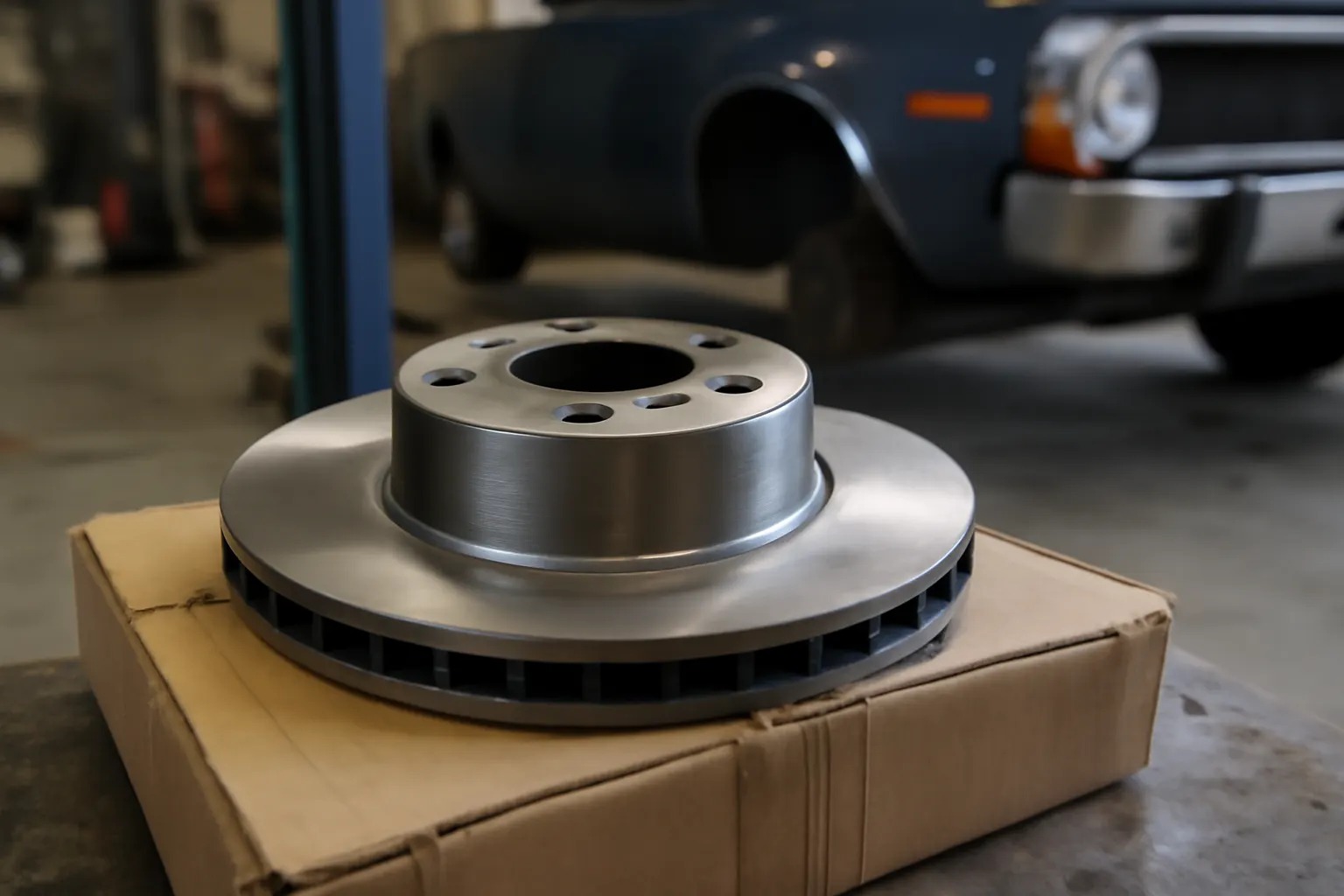
Amc Brake Rotor Materials
When it comes to restoring, maintaining, or upgrading classic AMC vehicles, understanding brake rotor material selection is essential for safety, performance, and authenticity. The material composition and venting patterns of AMC front brake rotors directly affect braking response, heat dissipation, rotor longevity, and even pedal feel. Whether you’re sourcing OEM replacements or considering performance upgrades, knowing the technical fundamentals behind AMC rotor materials gives you a decisive edge in diagnostics, fitment, and reliability.
Read More
Amc Vs Jeep Brake Rotors
A technical comparison of AMC, Jeep, and Chrysler front brake rotors is essential for anyone restoring classic vehicles, upgrading for performance, or simply maintaining the safety and function of their ride. The differences between these rotors extend far beyond branding—affecting fitment, materials, performance, and sourcing strategies. Whether you’re working on a 1970s AMC Javelin, a Jeep CJ, or a late-model Chrysler, understanding these distinctions is critical for restoration accuracy, driving safety, and optimal performance.
Read More
Amc Front Brake Rotor Guides
When searching for the correct AMC front brake rotor—whether for a classic restoration or daily driver maintenance—the most immediate need is a reliable cross-reference of part numbers, including supersessions and interchangeability with Jeep models. This guide delivers detailed cross-reference tables and practical fitment guidance, so you can confidently source, diagnose, and replace AMC front brake rotors without risking safety or compatibility issues.
View Guide