Advertisement
Stay ahead of Toyota frame structural issues, service advisories, and the latest OEM engineering updates with this comprehensive review of real-world shop reports and technical guidance. Whether you’re a repair professional, Toyota owner, or sourcing specialist, this blog delivers practical, up-to-date insights on frame front section fitment, corrosion recalls, and repair best practices. For a full overview of frame sourcing, fitment, and installation, see our Toyota Frame Front Section Only – OEM Fitment, Repair, and Sourcing Insights parent category.
Immediate Answer: What’s New in Toyota Frame Service?
Toyota frame concerns—especially involving the front section—continue to be a central topic in the automotive service world. In recent years, increased scrutiny from safety regulators, evolving SAE standards, and ongoing OEM updates have changed the landscape for both repair shops and Toyota owners. The latest service advisories emphasize early corrosion detection, precise frame section fitment, and adherence to new materials technologies for optimal structural integrity.
Key updates include:
- OEM engineering bulletins specifying revised weld points and material compositions.
- Shop reports revealing new diagnostic routines for hidden frame damage.
- NHTSA advisories and recalls targeting specific Toyota models with known corrosion vulnerabilities.
- Fuel efficiency implications tied directly to frame condition and repair quality.
If you maintain or repair Toyota trucks and SUVs, these developments directly impact your workflow, parts sourcing, and customer safety outcomes.
The Hidden Problem: Structural Risks and Service Gaps
While Toyota frames are engineered for longevity, real-world conditions—especially in regions with heavy road salt or high humidity—can accelerate corrosion and compromise the front section’s integrity. Many owners and even some technicians underestimate the severity of subframe and front section weaknesses until advanced failure occurs.
Hidden risks include:
- Undetected corrosion behind crossmembers or under mounting brackets.
- Improper section repairs that fail to restore original crash performance.
- Sourcing of non-OEM or poorly matched frame sections, leading to alignment issues or premature fatigue.
- Missed service advisories due to fragmented communication between OEMs, shops, and vehicle owners.
As a result, vehicles may pass basic inspections while harboring serious structural vulnerabilities that only become apparent during an accident, hard braking, or further disassembly.
Deeper Technical Explanation: Toyota Frame Front Section Engineering
OEM Materials and Structural Design
Toyota’s front frame sections—especially on Tacoma, Tundra, and 4Runner models—are designed using advanced high-strength steels and, in newer models, select lightweight alloys. The choice of materials directly impacts weight, durability, and crash energy management. According to the United States Department of Energy, modern vehicle frames increasingly rely on engineered steel blends and corrosion-resistant coatings to balance strength and fuel efficiency.
Critical Welds and Joint Placement
The frame front section integrates with suspension mounting points, engine cradles, and body supports via a network of precision welds and bolted joints. SAE standards, such as those outlined by SAE International, dictate allowable tolerances for weld penetration, joint geometry, and fastener torque. Deviations can result in misalignment, increased stress concentrations, or reduced crashworthiness.
Corrosion Pathways and Failure Modes
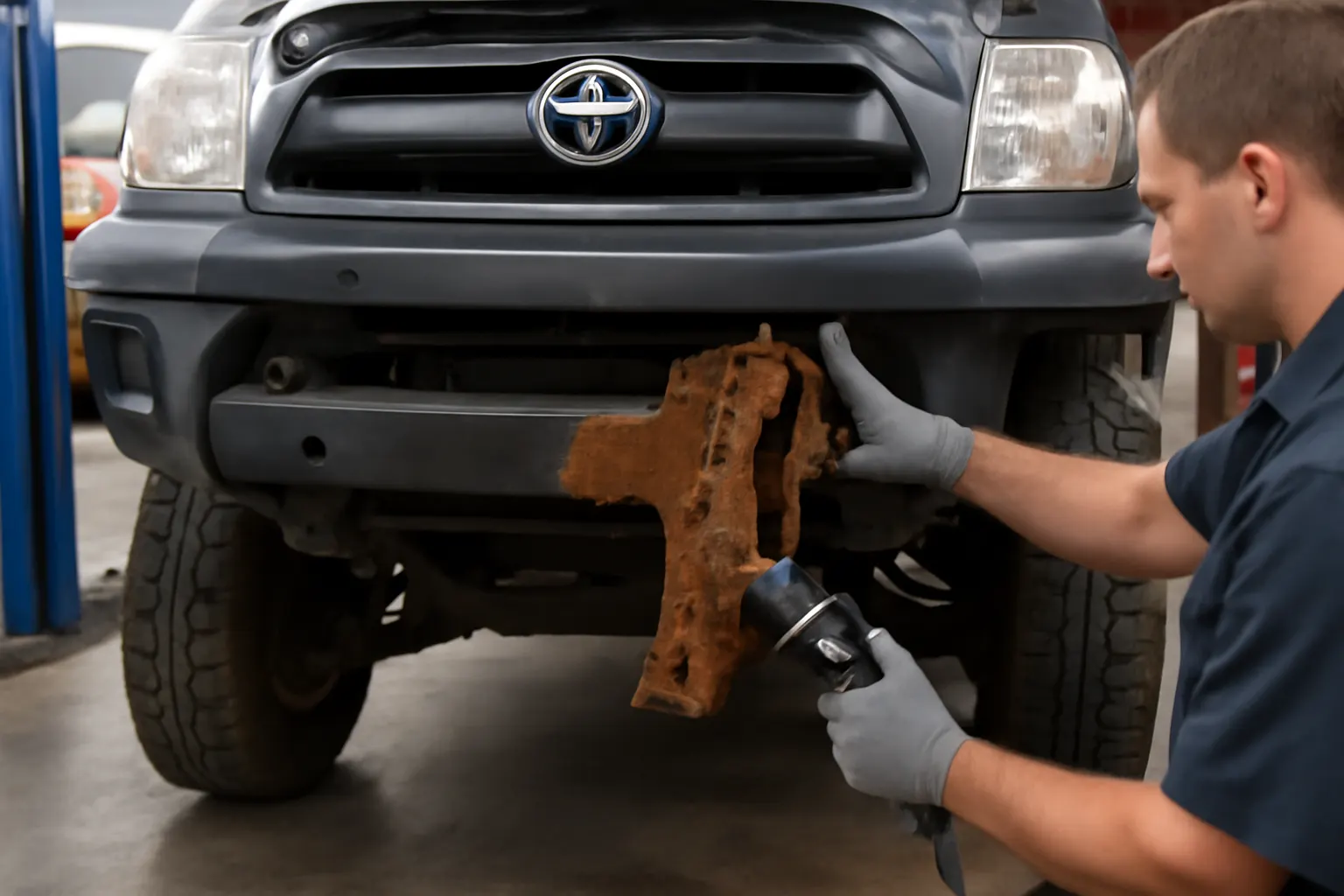
Corrosion most often initiates at seam welds, mounting brackets, or drain holes—especially if OEM coatings are breached during off-road use or minor impacts. Over time, rust can propagate internally, leading to frame perforation, separation at critical points, or even catastrophic failure under load. These risks are heightened in regions with aggressive de-icing chemicals or poor drainage.
Advertisement
Recent Service Advisories and Shop Reports
NHTSA Recall Activity
The National Highway Traffic Safety Administration (NHTSA) continues to monitor and issue recalls for Toyota frame corrosion and structural concerns. Recent advisories focus on:
- 2005–2010 Tacoma, Tundra, and Sequoia models with documented front section rust-through.
- Inspection protocols requiring removal of underbody shields and targeted frame probing.
- Mandatory frame section replacement where perforation or deep pitting is detected.
Shop-Level Diagnostic Trends
Shops report an uptick in frame section replacements, often triggered by failed state safety inspections or customer complaints of clunking, steering play, or visible rust. Advanced borescope inspections and ultrasonic thickness measurements are increasingly used to assess hidden corrosion before recommending repair.
Common Field Repairs
- Partial frame front section replacement using OEM-spec components.
- Reinforcement of mounting points with welded gussets or sleeves.
- Application of aftermarket corrosion inhibitors post-repair to extend service life.
Identifying Toyota Frame Front Section Issues: A Practical Checklist
When inspecting a Toyota for potential frame front section concerns, use this step-by-step checklist to ensure no critical detail is missed:
| Step | Inspection Point | What to Look For |
|---|---|---|
| 1 | Visual check (exterior) | Flaking paint, bubbling undercoating, visible rust at seams |
| 2 | Tap test | Hollow sounds indicating internal rust |
| 3 | Suspension/steering mounting points | Cracks, loose bolts, or rust trails |
| 4 | Borescope/ultrasonic test | Wall thickness, hidden corrosion |
| 5 | Underbody shield removal | Concealed rust, trapped moisture |
| 6 | Crossmember and bracket inspection | Pitting, weld separation |
| 7 | Frame measurement | Out-of-spec alignment, sagging |
| 8 | Review service history | Past repairs, corrosion treatment records |
A thorough approach reduces the risk of missed structural damage and ensures any required repairs are based on complete, accurate information.
The Impact of Frame Repairs on Fuel Efficiency and Safety
Frame integrity isn’t just about crash protection—it also affects fuel economy and long-term vehicle performance. According to the United States Department of Energy, excess frame weight from improper repairs or excessive reinforcement can decrease fuel efficiency, while misaligned sections can cause drivetrain drag and uneven tire wear.
Key implications:
- Excessive welds or added steel increase weight, reducing mileage.
- Misaligned frames stress suspension and steering, leading to premature part failure and increased rolling resistance.
- Improper corrosion repair can allow rust to return, undermining both safety and vehicle value.
OEM-style repairs that restore original material properties and geometry are essential for preserving both safety and efficiency outcomes.
Sourcing the Right Toyota Frame Front Section
OEM vs. Aftermarket Sections
- OEM frame sections are engineered to precise tolerances, with matching corrosion protection and weld patterns.
- Aftermarket units may lack critical reinforcements, use lower-grade steel, or require additional modification for fitment.
For most Toyota models, OEM sections remain the gold standard, especially for front section repairs where crash performance and alignment are critical.
Sourcing Best Practices
- Verify part numbers based on VIN and model year.
- Request material certification for steel grade and coating type.
- Inspect for shipping damage or improper welds before installation.
Refer to the Toyota Frame Fitment Guide for model-specific sourcing and compatibility tips.
Installation Insights: Achieving OEM-Level Results
Preparation and Fitment
- Dry-fit the section before final welding or bolting to ensure proper alignment.
- Clean and prep mating surfaces to bare metal, removing all rust and old coatings.
- Use OEM fasteners and weld techniques as specified by Toyota technical bulletins.
Advertisement
Welding and Assembly
- Follow SAE-approved weld procedures for penetration, bead length, and spacing.
- Monitor heat input to avoid warping or weakening adjacent metal.
- Reapply corrosion protection (e.g., e-coat, cavity wax) after welding and assembly.
For detailed step-by-step instructions, consult the Toyota Frame Front Section Installation guide.
Advanced Diagnostics: Tools and Techniques
Borescopes and Ultrasonic Thickness Gauges
- Borescopes allow internal inspection of closed frame sections for hidden rust or weld failures.
- Ultrasonic gauges measure wall thickness to detect thinning before perforation occurs.
Frame Alignment and Measurement Systems
- Laser alignment jigs verify frame straightness post-repair.
- Digital angle finders check mounting point geometry.
These diagnostics are increasingly standard in professional frame shops and are essential for documenting repair quality.
Real-World Shop Reports: Lessons from the Field
Case Study: 2008 Toyota Tacoma Front Section Replacement
A shop in the Northeast reported a 2008 Tacoma with advanced front frame corrosion, initially missed during a basic oil change. Upon closer inspection (using the checklist above), they discovered perforation near the lower control arm mount. The repair involved:
- Sectioning at factory weld points per Toyota guidelines.
- Using an OEM replacement section sourced with VIN verification.
- Reinforcing adjacent mounts with gusset plates.
- Reapplying OEM-style coatings post-weld.
The shop’s report emphasized the importance of thorough diagnostics and adherence to OEM repair procedures for both safety and customer satisfaction.
Staying Ahead: Monitoring Service Advisories and Recalls
How to Stay Informed
- Subscribe to OEM technical bulletins for model-specific frame updates.
- Monitor NHTSA recall databases for new advisories affecting Toyota frames.
- Network with local shops and online forums for emerging repair trends.
For a comprehensive list of known Toyota frame corrosion recalls and service actions, see our Toyota Frame Corrosion Recalls editorial page.
Preventive Maintenance: Extending Frame Life
Routine Inspection and Treatment
- Annual underbody inspections—especially after winter or off-road use.
- Application of rust inhibitors to high-risk areas.
- Prompt repair of chipped coatings or minor dents that breach corrosion protection.
Owner Education
- Encourage customers to wash underbodies regularly, especially in salt-prone regions.
- Provide documentation of inspections and preventive treatments for resale value.
Well-maintained frames are less likely to require major repairs and retain higher resale value.
Expert Action: Proactive Strategies for Shops and Owners
For Technicians and Shops
- Invest in advanced diagnostic tools (borescopes, ultrasonic gauges, laser alignment).
- Train staff on OEM repair standards and material handling.
- Document all repairs with before-and-after photos and measurement data.
For Toyota Owners
- Request frame inspections during major services or before purchasing used vehicles.
- Insist on OEM sections and certified repairs for any structural work.
- Stay informed about recalls and service advisories relevant to your model.
AutoPartEx: Your Partner in Toyota Frame Service Excellence
AutoPartEx is committed to providing technical accuracy, practical repair insights, and up-to-date sourcing guidance for all Toyota frame front section repairs. Our editorial and sourcing teams work with OEM partners, repair professionals, and industry experts to deliver the resources you need for safe, effective, and lasting frame repairs.
For more information on sourcing, fitment, and installation, visit our Toyota Frame Front Section Only – OEM Fitment, Repair, and Sourcing Insights page or browse our related guides for step-by-step instructions.
References
- Fuel Efficiency – United States Department of Energy
- SAE Standards – SAE International
- Materials Technologies – United States Department of Energy
- Vehicle, Car Seat, Tire, and Equipment Recalls – National Highway Traffic Safety Administration
- Vehicle Safety and Equipment – National Highway Traffic Safety Administration
Advertisement