Understanding Peugeot Electronic Systems
Peugeot’s modern vehicles are powered not just by engines and transmissions, but by sophisticated electronic systems that govern everything from fuel injection to anti-theft security. For owners, technicians, and parts buyers, understanding the essentials of Peugeot’s ECU (Engine Control Unit), BSI (Built-in Systems Interface), and CAN (Controller Area Network) systems is the fastest path to reliable diagnostics, cost-effective repairs, and long-term vehicle performance. This guide walks you through the intricacies of these core systems and explains how advanced diagnostics and genuine parts are key to keeping your Peugeot running at its peak.
If you’re seeking authentic, guaranteed-fit Peugeot components for these vital systems, visit our Peugeot Auto Parts: Authentic Quality, Fitment, and Heritage | AutoPartEx section for a curated selection and expert advice.
Peugeot Electronics: The Immediate Essentials
Peugeot’s electrical architecture revolves around three main pillars: the ECU, BSI, and the CAN bus. Each system plays a unique role:
- ECU (Engine Control Unit): The “brain” of the engine, managing ignition, fuel injection, emissions, and more.
- BSI (Built-in Systems Interface): Peugeot’s central hub for body electronics, controlling lights, wipers, security, and communications.
- CAN (Controller Area Network): The high-speed digital network that allows all modules—ECU, BSI, ABS, airbags, infotainment—to “talk” to each other efficiently.
These systems are interdependent. A fault in one can cause cascading issues across the vehicle, making accurate diagnostics and the right parts absolutely critical.
The Hidden Problem: Why Peugeot Electronics Can Be Challenging
Many Peugeot owners and independent workshops encounter frustrating electrical issues that seem to defy simple fixes. Symptoms can include intermittent warning lights, starting problems, non-functional accessories, or even complete immobilization. The root cause? Peugeot’s integrated electronics are highly sensitive to module compatibility, wiring integrity, and the use of correct replacement parts.
What’s often hidden from the surface is that Peugeot’s BSI and ECU are “matched” at the factory, with security coding and configuration unique to each car. Swapping modules with generic or used parts can lead to immobilizer lockout, persistent fault codes, or loss of key vehicle functions. Furthermore, the CAN network’s complexity means a single bad connection, corroded pin, or counterfeit component can disrupt the entire system.
Expanding the Challenge: Technical Interplay and Common Failure Points
ECU, BSI, and CAN: How They Work Together
- ECU: Monitors engine sensors (oxygen, temperature, throttle, crankshaft), processes data, and actuates injectors, ignition coils, and emission controls for optimal performance and fuel efficiency.
- BSI: Acts as the “nerve center” for body functions—door locks, lighting, climate control, alarm, and interface to the dashboard. It stores vehicle configuration and security codes.
- CAN Bus: The robust digital backbone, enabling real-time communication between all modules. When you unlock your car or start the engine, dozens of messages are exchanged instantly via the CAN bus.
Typical Peugeot Electronic Faults
- Random warning lights or “Christmas tree” dash: Often due to CAN bus errors, BSI faults, or poor ground connections.
- No start/immobilizer active: Can result from lost BSI-ECU pairing, key transponder issues, or failed BSI.
- Accessory failures (windows, wipers, lights): Frequently traced to BSI relay faults, blown fuses, or corroded connectors.
- Communication errors during diagnostics: Generic OBD tools may not access all Peugeot modules, leading to incomplete or misleading fault codes.
Why Generic Parts and “Plug-and-Play” Fixes Rarely Work
Unlike older vehicles, modern Peugeots require modules that are coded and configured for the exact VIN. Used or non-genuine ECUs and BSIs may lack the correct software, immobilizer pairing, or hardware compatibility, causing persistent problems or even bricking the car’s electronics.
In-Depth: The Peugeot ECU
What the ECU Controls
The Engine Control Unit is responsible for:
- Fuel injection timing and amount
- Ignition timing
- Turbo boost (where fitted)
- Emissions controls
- Idle speed
- Engine protection modes
How the ECU Learns and Adapts
Modern Peugeot ECUs are adaptive—they “learn” from sensor data over time to optimize performance and efficiency. This process, known as “self-adaptation,” means that replacing or resetting the ECU without proper initialization can lead to erratic performance or warning lights.
Common ECU-Related Issues
- Sensor failures: A bad MAP, MAF, or crank sensor can cause the ECU to enter limp mode.
- Wiring faults: Damaged harnesses or corroded connectors can interrupt ECU signals.
- Software corruption: Power surges or failed updates can brick the ECU, requiring reprogramming or replacement.
Understanding the BSI: Peugeot’s Body Control Center
BSI Functions
The Built-in Systems Interface (BSI) is unique to PSA Group vehicles and integrates:
- Central locking and alarm
- Lighting control
- Wiper operation
- Climate control interface
- Odometer and dashboard data
- Immobilizer and key recognition
BSI Coding and Configuration
Each BSI is coded to the car’s VIN and immobilizer system. This coding includes configuration for specific options—automatic headlights, rain sensors, power windows, etc. Swapping in a BSI from another vehicle without proper re-coding will almost always result in partial or total loss of function.
BSI Failure Symptoms
- Random electrical malfunctions
- Loss of central locking or alarm
- Non-start or immobilizer warning
- Dashboard display errors
- Water ingress (a common cause of BSI failure)
The CAN Bus: Peugeot’s Digital Backbone
What Is the CAN Bus?
The Controller Area Network (CAN) is a high-speed, fault-tolerant digital network that connects all major electronic modules. It allows for:
- Efficient, real-time data exchange
- Reduced wiring complexity
- Coordinated safety and convenience features
CAN Bus Issues
- Communication errors: May appear as “U” codes (e.g., U1000) during diagnostics.
- Intermittent electrical faults: Often caused by poor connections, damaged wiring, or aftermarket device installation.
- Module “dropout”: A single faulty module can “jam” the CAN bus, affecting multiple systems.
Diagnosing CAN Bus Problems
- Use a manufacturer-level scan tool to read all modules.
- Check CAN wiring for continuity and resistance.
- Inspect connectors for corrosion or water ingress.
Modern Diagnostics: Tools and Best Practices
Why Generic OBD-II Scanners Fall Short
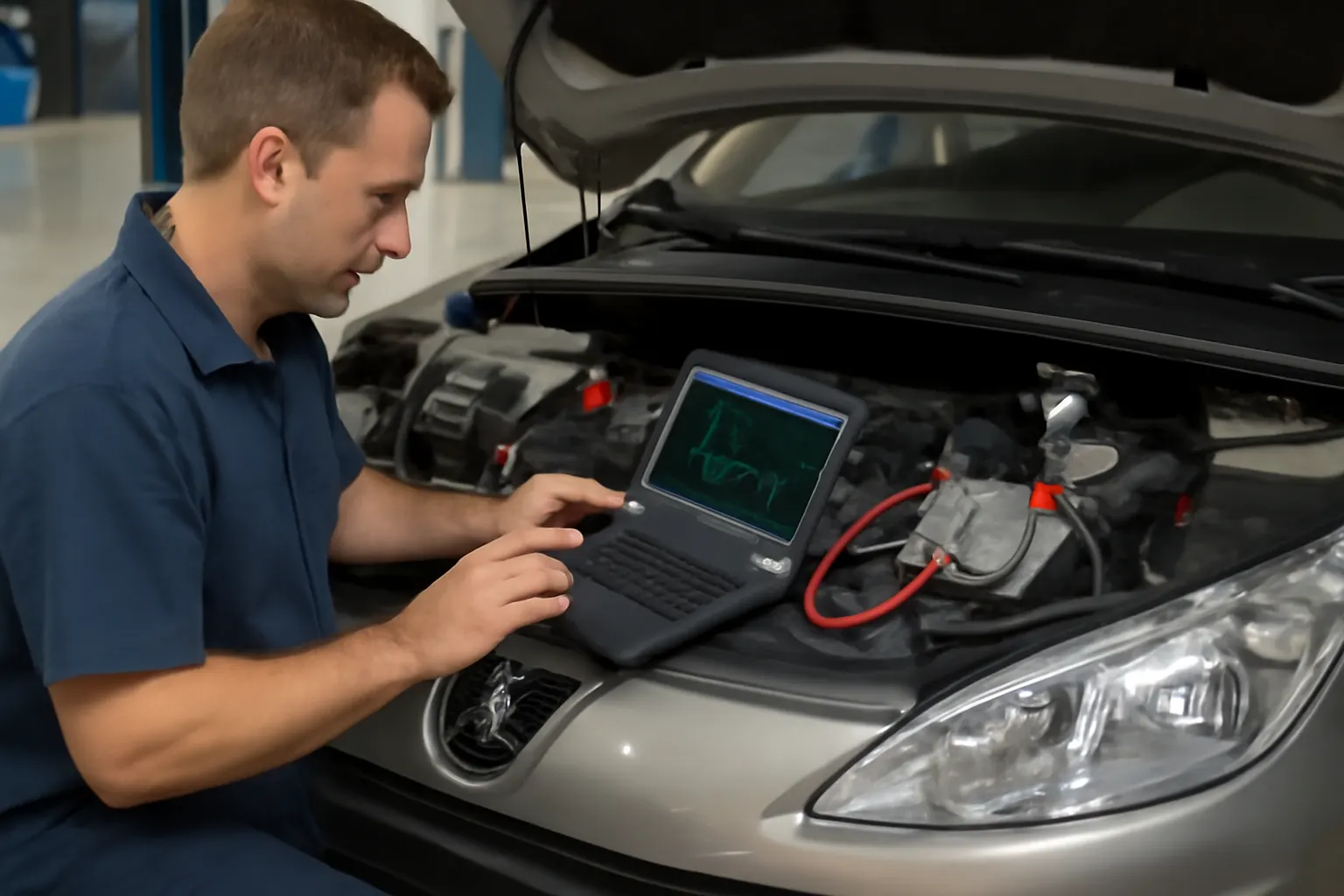
While basic OBD-II tools can read engine codes, Peugeot’s proprietary systems require advanced diagnostic equipment (such as Peugeot Planet or Diagbox) to:
- Access BSI, airbag, ABS, and other modules
- Perform coding and configuration
- Run actuator tests and parameter reads
- Reset adaptation values after repairs
Diagnostic Checklist for Peugeot Electronics
- Scan all modules: Use a PSA-compatible tool.
- Check battery voltage: Low voltage can trigger false codes.
- Inspect wiring and grounds: Especially at ECU, BSI, and main harness connectors.
- Look for water ingress: Common in BSI and under-hood fuse boxes.
- Validate part numbers: Ensure any replacement ECU/BSI matches your VIN and options.
- Check for recalls: Some electronic faults may be covered by manufacturer recalls (NHTSA recalls).
Sourcing Genuine Peugeot Electronic Parts
Why OE and Genuine Parts Matter
Because of the tight integration and security coding in Peugeot electronics, using genuine parts is essential. Aftermarket or counterfeit ECUs, BSIs, and sensors may:
- Fail to program correctly
- Cause persistent warning lights
- Lead to immobilizer lockout
- Void safety and compliance standards (Vehicle Safety and Equipment)
How to Identify Genuine Peugeot Electronics
- Check packaging and labeling: Genuine parts have PSA or Peugeot branding, holograms, and correct part numbers.
- Buy from trusted sources: Use reputable dealers, or AutoPartEx’s Peugeot parts catalog.
- Verify compatibility: Cross-check part numbers against your VIN (Peugeot VIN Decoding and Parts Compatibility Guide).
Risks of Counterfeit or Used Modules
- Inoperable immobilizer
- Loss of safety-critical features (airbags, ABS)
- CAN bus errors and cascading electrical failures
- Potential for vehicle lockout or bricking
For more on avoiding fakes, see Counterfeit Peugeot Parts: How to Spot and Avoid Them.
Installation and Coding: Getting It Right
ECU and BSI Replacement Steps
- Obtain the correct part: Must match original hardware and software version.
- Pre-programming: Some modules require coding before installation.
- Install using anti-static precautions: Avoid static discharge which can damage sensitive electronics.
- Pairing/Coding: Use a dealer-level tool to:
- Code the ECU and BSI to your VIN
- Program keys and immobilizer
- Configure vehicle options (lighting, wipers, etc.)
- Test all functions: Confirm no warning lights or lost features.
Professional vs. DIY
While some skilled DIYers can handle basic sensor replacements, ECU or BSI swaps almost always require specialist tools and knowledge. Incorrect installation or coding can leave the car immobilized.
Maintenance and Longevity: Protecting Your Peugeot’s Electronics
Preventive Maintenance Checklist
- Keep battery and charging system healthy: Low voltage is a top cause of electronic glitches.
- Inspect for water leaks: Especially around the BSI (often under the dashboard) and fuse boxes.
- Check wiring harnesses: Look for abrasion, corrosion, or rodent damage.
- Update software: Dealer updates can fix bugs and improve reliability.
- Avoid jump-starting with incorrect procedures: Always follow Peugeot’s guidelines to prevent voltage spikes.
Longevity Tips
- Don’t ignore warning lights: Early diagnosis prevents bigger failures.
- Use only compatible bulbs and fuses: Incorrect amperage can overload circuits.
- Keep connectors and grounds clean: Use dielectric grease where appropriate.
- Schedule regular diagnostic scans: Catch intermittent faults before they escalate.
Safety and Compliance: Why Proper Electronics Matter
Peugeot’s electronic systems are integral to safety features such as airbags, ABS, and stability control. Faulty or mismatched modules can compromise these systems, potentially putting occupants at risk. Using OE-quality parts not only ensures correct operation but also maintains compliance with safety standards (Vehicle Safety and Equipment; SAE Standards).
Improving Reliability with Modern Diagnostics
How Diagnostics Enhance Reliability
- Faster fault identification: Targeted scans reduce guesswork and unnecessary parts replacement.
- Accurate module coding: Ensures all features function as designed.
- Preventative data: Early detection of voltage drops, intermittent CAN errors, or sensor drift.
The Role of Software Updates
Peugeot regularly issues software updates to fix bugs, improve fuel efficiency, and enhance safety features (Fuel Efficiency). Keeping your modules updated is as important as maintaining the hardware.
Expert Solution Path: Step-by-Step Approach to Peugeot Electronics
- Symptom identification: Note all warning lights, error messages, and malfunctions.
- Full vehicle scan: Use a PSA-compatible diagnostic tool to read all modules.
- Visual inspection: Check battery, fuses, connectors, and for signs of water damage.
- Research part numbers: Confirm correct replacements using your VIN.
- Source genuine parts: Avoid used or generic modules unless they can be professionally re-coded.
- Professional installation and coding: For ECUs and BSIs, always use specialist tools and expertise.
- Test and validate: Confirm all systems operate as designed before returning the vehicle to service.
AutoPartEx: Your Peugeot Electronics Partner
AutoPartEx specializes in authentic Peugeot electronic components, VIN-matched fitment, and technical guidance for DIYers and professionals. We offer:
- VIN-based part lookup: Ensure every module is compatible with your specific Peugeot.
- Expert technical support: Get help with diagnostics, coding, and installation.
- Counterfeit screening: Buy with confidence knowing every part is OE-quality.
- In-depth guides: From Peugeot Service Intervals and Maintenance Checklist to decoding your VIN, we support your ownership journey.
Don’t risk your Peugeot’s reliability or safety with questionable electronics. Trust AutoPartEx for guaranteed-fit solutions and ongoing support.