
Advertisement
Servicing an AMC carrier—whether for classic restoration, off-road reliability, or daily driver longevity—demands precision, up-to-date technical knowledge, and a clear understanding of common pitfalls. This AutoPartEx guide delivers shop-tested AMC carrier service tips, focusing on bearing setup, torque specifications, and installation best practices. Proper carrier maintenance is central to drivetrain performance, safety, and the overall health of your AMC axle assembly. For comprehensive part fitment, diagnostics, and sourcing, refer to our AMC Carrier Parts: Fitment, Diagnostics & Sourcing Guide | AutoPartEx.
Immediate Answer: AMC Carrier Service Essentials
The most critical AMC carrier service tips are:
- Always use manufacturer-specified torque values for carrier bearing caps and ring gear bolts.
- Verify proper bearing preload and backlash using precision tools.
- Replace all seals and inspect shims during any carrier service.
- Clean all mating surfaces meticulously to prevent leaks and misalignment.
- Avoid mixing old and new carrier bearings or races.
These fundamentals prevent premature wear, noise, and catastrophic failure. Following these steps ensures your AMC axle remains quiet, efficient, and reliable, whether you’re dealing with a Model 20, Model 35, or other AMC differentials.
The Hidden Problem: Overlooked Service Details Lead to Costly Failures
Many AMC enthusiasts and even seasoned mechanics underestimate the complexity of carrier service. The issues most often arise not from catastrophic component failures, but from subtle errors during setup:
- Improper bearing preload can cause excessive heat, rapid wear, or bearing spin.
- Incorrect torque sequence or values may warp the carrier or allow ring gear movement.
- Neglecting to check backlash can result in noisy operation or gear tooth damage.
- Reusing old shims or seals compromises sealing integrity and gear alignment.
- Improper cleanliness introduces abrasive debris, risking early failure.
These hidden pitfalls can lead to expensive repairs, reduced drivetrain efficiency, and even safety concerns—especially if the vehicle is used in demanding conditions.
Technical Deep Dive: AMC Carrier Construction and Service Challenges
AMC carriers, whether in the iconic AMC 20 or lighter AMC 35, are engineered for strength and durability but require precise service protocols. The carrier assembly consists of:
- Carrier housing: Holds the differential gears and supports the ring gear.
- Carrier bearings: Support the carrier within the axle housing, requiring correct preload.
- Shims: Set bearing preload and gear backlash.
- Ring and pinion gear set: Transmits torque from the driveshaft to the wheels.
- Bearing caps: Secure the carrier assembly inside the axle housing.
- Seals: Prevent lubricant leaks and contamination.
AMC designs often use shims between the bearings and carrier or between the carrier and housing to adjust preload and backlash. This design is robust but unforgiving of errors in setup. Modern materials and lubricants have improved performance, but the fundamentals of mechanical fitment remain unchanged (DOE Materials Technologies).
Bearing Setup: Preload, Installation, and Inspection
Proper bearing setup is the backbone of AMC carrier longevity. Here’s how to get it right:
Preload Setting
- Measure with an inch-pound torque wrench: Rotate the carrier and record the resistance. Compare to AMC’s spec (consult model-specific manuals).
- Adjust shims as needed: Add or subtract shims to achieve correct preload.
Installation Steps
- Press new bearings onto the carrier using a properly sized driver. Avoid hammering, which can damage the bearing.
- Install carrier into the axle housing with temporary setup bearings (if available), then finalize shim thickness.
- Check for smooth rotation and correct preload before final assembly.
Inspection
- Visually inspect bearings for scoring, pitting, or discoloration.
- Spin bearings by hand: Any roughness or noise indicates replacement is needed.
Advertisement
AMC Carrier Bearing Setup Checklist
- Clean all bearing and mating surfaces.
- Use only new bearings and races for rebuilds.
- Set preload to manufacturer’s spec.
- Check for smooth, noise-free rotation.
- Re-inspect after initial run-in.
Torque Specifications: AMC Carrier Fastener Guide
Using the correct torque values is non-negotiable for safety and performance. Over- or under-torquing can lead to catastrophic failures or persistent leaks.
Common AMC Carrier Torque Specs
| Component | Torque Spec (ft-lbs) |
|---|---|
| Carrier Bearing Caps | 55-60 (check model manual) |
| Ring Gear Bolts | 55-65 (use Loctite) |
| Pinion Nut | 210-300 (crush sleeve type) |
| Axle Shaft Retainers | 20-25 |
Always verify specs for your specific AMC model. Use a calibrated torque wrench and follow a cross-pattern sequence for even clamping (NHTSA Equipment).
Backlash and Gear Pattern: Setting Up for Quiet Operation
Backlash—the play between the ring and pinion gear teeth—is critical for noise-free, efficient operation.
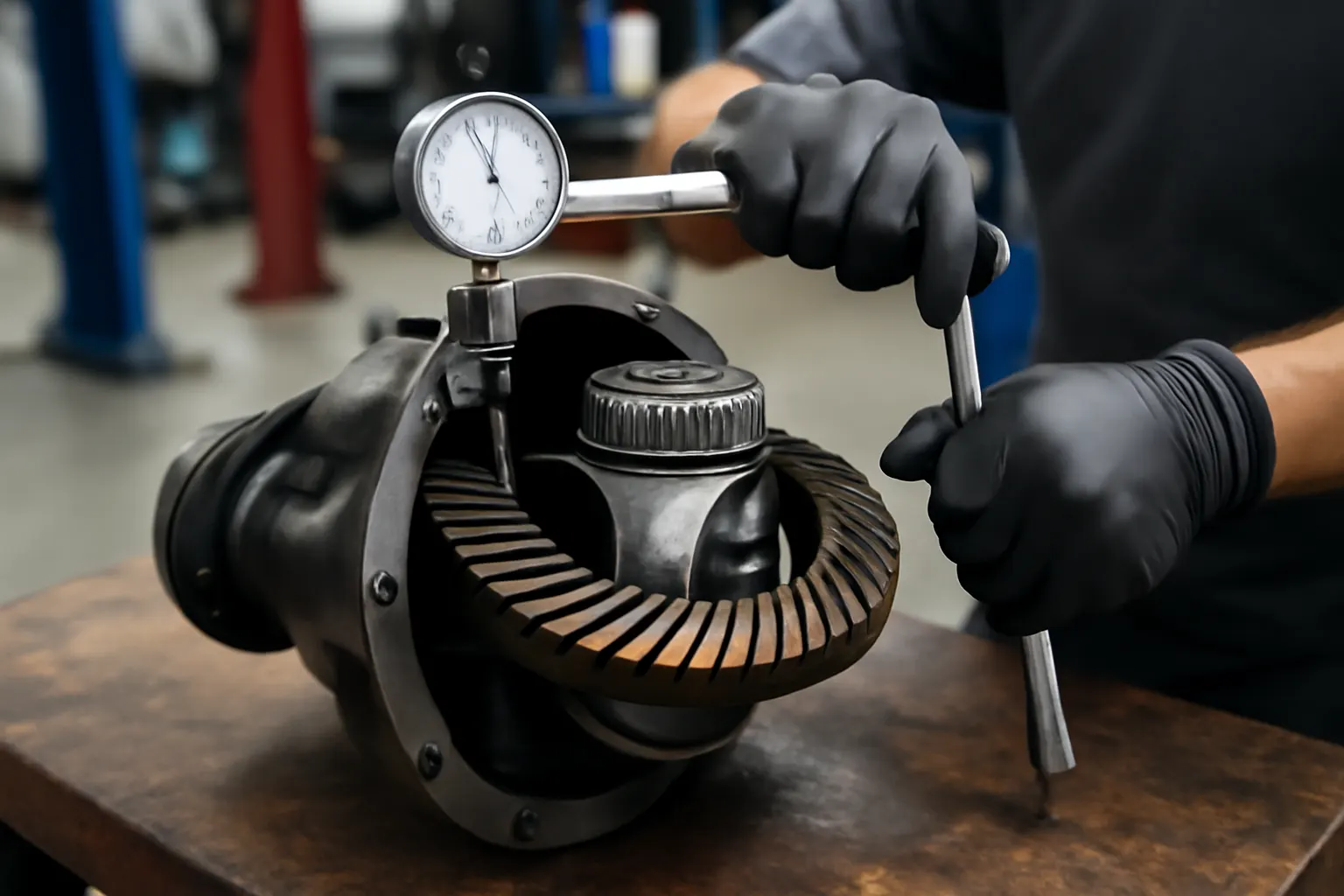
Measuring Backlash
- Use a dial indicator mounted to the axle housing.
- Target spec: Typically 0.006"–0.010" for AMC axles (verify for your application).
- Adjust by shifting carrier shims side to side.
Checking Gear Pattern
- Apply gear marking compound to several ring gear teeth.
- Rotate the carrier through several revolutions in both directions.
- Inspect the pattern: It should be centered and evenly distributed across the tooth face.
Improper backlash or pattern leads to whine, premature wear, and eventual gear failure.
Seal Replacement: Preventing Leaks and Contamination
Old, hardened, or misaligned seals are a leading cause of carrier fluid leaks. Leaks not only reduce lubrication but also allow contaminants into the gear set.
Best Practices
- Always replace axle and pinion seals during carrier service.
- Use a seal installer tool to ensure even, square installation.
- Lightly lubricate the seal lip with gear oil before installation.
- Inspect the sealing surface on the shaft for grooves or corrosion; polish or replace as needed.
A leak-free AMC carrier ensures long-term reliability and keeps your axle internals protected from dirt and water.
Cleanliness: The Often-Ignored Key to Carrier Longevity
Microscopic debris left inside the carrier or axle housing acts like sandpaper, accelerating wear. Even a single stray metal shaving can destroy new bearings or gears.
Service Tips
- Thoroughly clean all components with solvent and compressed air.
- Wipe mating surfaces with lint-free towels.
- Flush the axle housing if possible.
- Inspect for nicks or burrs on all sealing and mating surfaces.
Never reuse dirty parts or allow shop rags to shed lint inside the assembly.
Shim Selection and Setup: Achieving Correct Preload and Backlash
Shim selection is both art and science. AMC carriers use shims to set both bearing preload and ring gear backlash. Incorrect shim stacks lead to noisy operation, rapid wear, or even catastrophic gear failure.
Shim Setup Procedure
- Begin with a baseline shim stack (from teardown or manual).
- Install carrier with setup bearings (if available) and measure backlash and preload.
- Adjust shims incrementally:
- To increase preload, reduce shim thickness.
- To decrease backlash, move shims toward the ring gear side.
- Recheck measurements after each adjustment.
Tip: Always record shim thicknesses and settings for future reference.
Common Installation Pitfalls: What to Avoid
Even experienced mechanics can fall into these traps:
- Mixing old and new bearings or races: Always replace as a matched set.
- Skipping pattern checks: Never assume gears will mesh quietly just because backlash is correct.
- Over-tightening bearing caps: Can distort the carrier and create uneven bearing load.
- Forgetting thread locker on ring gear bolts: Risk of bolts backing out, leading to catastrophic failure.
- Not rechecking torque after initial run-in: Some settling may occur.
Advertisement
Avoiding these pitfalls is the difference between a quiet, reliable AMC axle and one that requires repeated service.
Diagnostic Tips: Identifying Carrier Issues Before They Worsen
Early detection of carrier issues can save you from major repairs. Common symptoms include:
- Whining or howling noises: Usually indicate incorrect backlash or worn bearings.
- Clunking or banging: May signal excessive backlash or broken gear teeth.
- Leaking fluid around axle ends or pinion: Points to failed seals.
- Vibration under load: May be caused by carrier misalignment or excessive wear.
If you notice any of these symptoms, consult our Amc Carrier Diagnostics guide for step-by-step troubleshooting.
Sourcing Quality AMC Carrier Parts
Not all replacement parts are created equal. Using substandard bearings, seals, or gears can undermine even the best installation practices.
What to Look For
- OEM or reputable aftermarket brands: Ensure compatibility and longevity.
- SAE- or OEM-certified components: Meet or exceed original standards (SAE Standards).
- Precision-machined shims and fasteners: For accurate setup.
- Seals made of modern, durable materials: Resist hardening and leaks.
For a comprehensive sourcing and fitment guide, see our AMC Carrier Fitment resource.
Maintenance Intervals and Best Practices
Regular maintenance extends the life of your AMC carrier and prevents expensive failures.
Maintenance Schedule
- Check fluid level and condition every 15,000 miles.
- Inspect for leaks at every oil change.
- Re-torque carrier bearing caps and ring gear bolts after 500 miles on new builds.
- Change gear oil every 30,000–50,000 miles or after severe use (off-roading, towing).
Best Practices
- Use the correct grade of gear oil (typically 80W-90 or as specified).
- Add friction modifier if required for limited-slip differentials.
- Monitor for unusual noises or leaks after any service.
Carrier Service Checklist: Step-by-Step Reference
Here’s a quick-reference checklist for AMC carrier service:
-
Disassembly
- Drain gear oil and remove axle shafts.
- Remove carrier bearing caps and carrier assembly.
- Mark bearing cap orientation for reassembly.
-
Inspection
- Inspect bearings, races, gears, and shims for wear or damage.
- Check for metal debris or discoloration.
-
Preparation
- Clean all parts and housing thoroughly.
- Lay out new bearings, seals, and shims.
-
Installation
- Press new bearings onto the carrier.
- Install new races into the housing.
- Set up shims for correct preload and backlash.
- Torque caps and ring gear bolts to spec.
-
Final Checks
- Verify backlash and gear pattern.
- Install new seals and lubricate.
- Refill with specified gear oil.
-
Post-Service
- Road test for noise, leaks, or vibration.
- Re-torque fasteners after break-in period.
Advanced Tips: Performance and Longevity Upgrades
For high-performance or off-road AMC builds, consider these advanced service tips:
- Upgrade to Timken or similar premium bearings for greater load capacity.
- Install a girdle or reinforced cover for additional carrier support.
- Use synthetic gear oil for improved lubrication under extreme conditions.
- Consider a solid spacer in place of a crush sleeve (where applicable) for more precise pinion preload.
- Upgrade to chromoly axles or heavy-duty carrier cases for extreme use.
These upgrades, combined with proper service techniques, dramatically enhance durability and performance.
AutoPartEx: Your AMC Carrier Service and Sourcing Partner
AutoPartEx is committed to supporting AMC enthusiasts and professionals with the most accurate, shop-tested technical information and the highest quality replacement parts. Our editorial team continually updates guides to reflect the latest standards and best practices, ensuring your AMC carrier service is safe, reliable, and efficient.
For further reading, explore our Amc Axle Carrier Evolution article to understand how AMC differential technology has progressed over time. For all your AMC carrier parts, fitment, and sourcing needs, visit the AMC Carrier Parts: Fitment, Diagnostics & Sourcing Guide | AutoPartEx.
References
Advertisement